
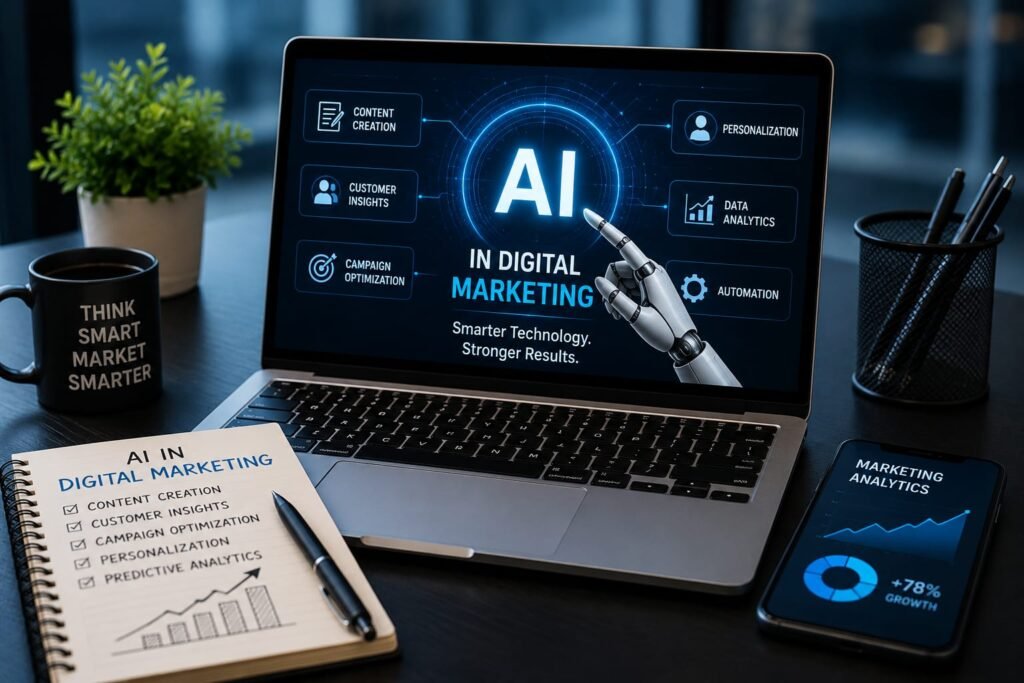
What Is AI in Digital Marketing?
AI in digital marketing means using artificial intelligence, which is software that can learn from data, recognize patterns and generate content or decisions, to plan, run and improve your marketing.
You are probably already using it without noticing:
- Google suggesting search terms as you type
- Netflix or YouTube recommending what to watch next
- Instagram showing you ads that feel oddly relevant
- A chatbot answering your question on a shopping website at 2 AM
In marketing, AI mainly does three things:
- Analyzes huge amounts of data far faster than any human
- Predicts what customers might want or do next
- Creates content such as text, images, video and audio (this is called generative AI)
Why AI Is Changing Digital Marketing So Fast
Marketing has always been about the right message, to the right person, at the right time. The problem was that doing this well needed time, money and a lot of guesswork.
AI makes it faster, cheaper and smarter. It lets even a tiny business do things that once only big companies could afford. That is the real transformation: AI is making good marketing more accessible.
Now let’s look at the key areas where this change is happening.
1. AI Is Transforming Content Creation
This is the area most people notice first. Generative AI in marketing can help you with:
- Brainstorming blog topics and headlines
- Creating outlines and first drafts
- Writing email subject lines and ad copy
- Repurposing one blog into social posts, reels scripts and newsletters
- Creating images, graphics and short videos
- Translating content into multiple languages, including Hindi and Hinglish
But here is the honest truth: AI can give you a draft, not a soul. Readers can feel when content is copied, generic or empty. The brands that win are those that add real experience, personal stories, opinions and original examples on top of AI help.
A simple rule I follow: let AI help you start, but let your own voice finish.
2. AI Is Transforming SEO
Since you are reading this on a digital marketing website, this part matters a lot. AI for SEO is changing how we research, write and rank.
How AI helps SEO professionals:
- Keyword research: Finding related keywords, questions and topic clusters in minutes
- Search intent analysis: Understanding what people really want when they search
- Content gap analysis: Spotting topics your competitors cover that you have missed
- On-page suggestions: Improving titles, headings and meta descriptions
- Technical audits: Detecting broken links, slow pages and indexing issues faster
How AI is changing search itself:
Search engines now use AI to give direct summaries and answers at the top of results. People also ask questions to AI assistants instead of typing short keywords. This means:
- Search is becoming more conversational. People type full questions, so your content should answer full questions.
- Clear, helpful, well-structured content gets noticed. Short answers followed by deeper explanations work well.
- Trust matters more than ever. Google talks about E-E-A-T, which stands for Experience, Expertise, Authoritativeness and Trustworthiness. Showing real experience in your content is your biggest advantage over mass-produced AI text.
Do not worry that AI makes SEO dead. SEO is simply growing up. If you want to refresh your basics, read our guide on what SEO is in digital marketing here on DigiInsightsHub.
3. AI Is Transforming Personalization
Imagine walking into a shop where the owner remembers your name, your size and what you bought last time. That feels special, right? AI personalization brings that feeling to online marketing.
AI can study a customer’s browsing, past purchases and interests to:
- Show product recommendations that actually fit them
- Send personalized emails with the right offer at the right time
- Change website content based on who is visiting
- Suggest the next best action for each lead
When people feel understood, they trust you more and buy more. The key is to use data respectfully and transparently, which we will talk about shortly.
4. AI Is Transforming Paid Advertising
If you run Google Ads or Meta Ads, you have already seen AI at work.
- Smart bidding adjusts your bids automatically to chase better results
- Audience targeting finds people most likely to convert
- Creative testing tries different headlines, images and descriptions to see what works
- Budget optimization moves spend toward better-performing campaigns
- Performance prediction helps estimate results before you spend heavily
This saves hours of manual work. But remember, AI optimizes what you tell it to optimize. If your goal, tracking or landing page is weak, AI will simply get you the wrong results faster. Strategy still starts with you.
5. AI Is Transforming Customer Support with Chatbots
Customers today expect quick answers. AI chatbots for business can reply instantly on your website, WhatsApp or social media, 24 hours a day.
They can:
- Answer common questions about pricing, timing and delivery
- Help customers find the right product
- Collect lead details such as name, phone and requirement
- Book appointments or demos
- Hand over complex issues to a human team member
The magic word is hand over. The best chatbots do not try to replace people. They handle the simple stuff so your team can give real attention to the important conversations.
6. AI Is Transforming Email Marketing
Email is still one of the strongest marketing channels, and AI makes it better by helping with:
- Writing and testing subject lines
- Finding the best time to send for each subscriber
- Segmenting your list based on behavior and interests
- Predicting who may unsubscribe or who is ready to buy
- Personalizing content for each reader
Even a small list of loyal subscribers can drive great results when emails feel personal and helpful.
7. AI Is Transforming Social Media Marketing
Social media moves quickly, and AI helps you keep up. It can suggest content ideas, write captions, find trending topics, recommend the best posting times, and analyze which posts perform best.
AI also helps with social listening, which means tracking what people say about your brand or industry online. This gives you early signals about customer needs, complaints or trends.
One caution: audiences love real faces, real stories and real emotions. Do not let AI turn your brand into a robot. Show up as a human being.
8. AI Is Transforming Data Analytics and Decision Making
Marketers drown in data: website visits, clicks, ad numbers, sales, reviews. AI helps turn this mess into meaning by:
- Spotting patterns humans may miss
- Creating quick summaries and reports
- Predicting trends and customer behavior
- Highlighting what is working and what is wasting money
This means faster, smarter decisions. But numbers do not explain feelings. You still need human judgment to understand why people behave the way they do.
What AI Can Do vs What Humans Must Do
Task | AI Is Great At | Humans Are Essential For |
|---|---|---|
Content | Drafts, ideas, repurposing, translation | Original stories, emotion, opinion, brand voice |
SEO | Research, audits, suggestions | Strategy, experience, trustworthy insights |
Ads | Bidding, testing, targeting | Goals, messaging, offer, creative direction |
Support | Instant replies, FAQs | Empathy, problem-solving, relationships |
Analytics | Crunching data, spotting patterns | Understanding why, making final decisions |
Remember this table. The future belongs to marketers who combine AI speed with human wisdom.
Popular AI Tools Marketers Are Using
You do not need all of these. Explore a few and see what fits your work.
- AI writing and thinking assistants such as ChatGPT, Claude and Gemini for ideas, outlines, drafts and analysis
- Canva (with its AI features) for quick graphics and social media designs
- SEO tools with AI features such as Semrush, Ahrefs, Surfer SEO and Rank Math
- Google Ads and Meta Ads AI features such as smart bidding and Advantage+ campaigns
- Email platforms with AI such as Mailchimp, Klaviyo and similar tools
- AI video and audio tools for captions, voiceovers and short clips
Tool names and features change often, so always check the latest features before choosing a paid plan.
How to Start Using AI in Your Digital Marketing: A 6-Step Plan
Step 1: Pick one problem. Do not try to use AI everywhere. Choose one slow, repetitive task, like writing email subject lines or researching keywords.
Step 2: Learn to give clear instructions. AI gives better answers when you give better prompts. Tell it who you are, who the audience is, what the goal is, what tone you want, and what format you need.
Step 3: Treat AI output as a first draft. Never publish blindly. Read it, fix it, and add your own experience.
Step 4: Fact-check everything. AI can sound confident and still be wrong. Verify numbers, names, claims and dates.
Step 5: Add your human touch. Include personal stories, real client examples, your opinions and lessons learned. This is what makes content truly yours and valuable to readers.
Step 6: Measure and improve. Track what works using Google Analytics and Search Console. Keep what improves results and drop what does not.
A Better Way to Write Prompts (With Example)
Weak prompt: “Write about social media marketing.”
Strong prompt: “Act as a digital marketing trainer. Write a beginner-friendly explanation of social media marketing for small business owners in India. Use simple English, short paragraphs and one real-life example. Keep it under 300 words.”
See the difference? The more context you give, the more useful the answer.
The Challenges and Risks of AI in Marketing
AI is powerful, but it is not perfect. Keep these risks in mind:
- Generic content: If everyone uses the same prompts, everyone sounds the same. Originality becomes your edge.
- Mistakes and made-up facts: AI can produce incorrect information that sounds believable.
- Privacy and data protection: Be careful with customer data. Follow privacy rules and never paste sensitive information into tools you do not trust.
- Bias: AI learns from human data, so it can repeat unfair patterns. Review content for fairness.
- Over-dependence: If you stop thinking, your skills will weaken. Use AI as a helper, not a crutch.
- Loss of authenticity: Customers can sense when a brand has no real personality behind it.
Ethical AI Marketing: Doing the Right Thing
Trust is the most valuable thing a brand owns. To protect it:
- Be honest about how you use customer data
- Do not create fake reviews, fake testimonials or misleading images
- Do not make false claims in AI-written content
- Give credit when you use others’ ideas
- Always keep a human in charge of final decisions
Will AI Replace Digital Marketers?
This is the question everyone asks, so let’s answer it honestly.
AI will change many tasks, and some routine jobs will look different. But marketing is about understanding people, and people are complicated. Creativity, empathy, storytelling, ethics and strategic thinking remain deeply human strengths.
A useful way to say it: AI may not replace marketers, but marketers who know how to use AI may replace those who do not. So the smartest move is to start learning now, calmly and consistently.
Skills to Learn to Stay Ahead in the AI Era
- Prompt writing: Asking AI the right questions
- Strategic thinking: Knowing what to do and why
- Storytelling and copywriting: Connecting emotionally
- Data reading: Understanding analytics and what the numbers mean
- SEO fundamentals: Search is still how people find answers
- Critical thinking: Checking AI output with a sharp mind
- Adaptability: Being willing to keep learning
The Future of Digital Marketing with AI
Looking ahead, expect marketing to become more personalized, conversational and automated. Search will feel more like a conversation. Content will be created faster, so quality and trust will matter even more. Small businesses will compete with bigger players using smart tools.
But one thing will never change: people want to feel seen, helped and respected. Brands that remember this will thrive, with or without the latest tool.
Frequently Asked Questions (FAQs)
1. How is AI transforming digital marketing? AI is changing how marketers research, create content, optimize SEO, target ads, personalize emails, support customers and analyze data. It saves time and helps make smarter decisions.
2. Is AI-generated content good for SEO? Google focuses on content quality and helpfulness rather than who or what wrote it. AI-assisted content can do well if it is accurate, original and genuinely useful, with real human experience added. Low-quality, copy-paste AI content usually does not.
3. Can small businesses use AI in marketing? Yes. Many AI tools are affordable or have free plans, and they help small businesses write content, design creatives, answer customers and run better ads without big teams.
4. Will AI replace digital marketers? Unlikely. AI will take over repetitive tasks, but creativity, strategy, empathy and ethical judgment still need humans. Marketers who learn to work with AI will have a big advantage.
5. What is the best AI tool for digital marketing? There is no single best tool. The right choice depends on your goal, such as writing, design, SEO, ads or email. Start with one or two tools, test them, and build from there.
6. How can a beginner start learning AI for marketing? Pick one small task, try a free AI assistant, practice writing clear prompts, always review and edit the output, and track the results. Learn a little every day.
Final Thoughts
So, how is AI transforming digital marketing? It is making marketing faster, smarter and more personal. It is helping with content, SEO, ads, email, social media, customer support and analytics. And it is opening doors for beginners and small businesses that never had them before.
But the heart of marketing is still human. Your stories, your experience, your honesty and your care for your audience are things no tool can copy.
So do not fear AI. Learn it, test it, question it, and use it wisely. Start with one small step today, maybe by using AI to plan your next blog post, and then add your own voice to it.
The future of digital marketing is not AI versus humans. It is AI with humans.
Want to keep learning? Explore our beginner-friendly guides on SEO, social media marketing and Google Ads here on DigiInsightsHub, and tell us in the comments which AI marketing topic you want us to explain next.
Keep learning, keep experimenting!